Hindi (in the broad sense) is a subset of the Indic language family in the northern plains of India, bounded on the northwest and west by Punjabi, Sindhi, Gujarati and Marathi; on the east by Bengali; and on the north by Nepali. As defined by the 1991 Indian census, Hindi covers a number of Central, East-Central, Eastern, and Northern Zone languages, including the Bihari languages, the Rajasthani languages, and the Pahari languages excepting Dogri and Nepali. They are conventionally divided into Western and Eastern Hindi. However, they do not form a natural clade, as which varieties are considered Hindi, and which not, are determined by social convention rather than to anything intrinsic.
"Hindi" in the narrow sense of one of the official languages of India is a standardized register of one of the Central Zone dialects variously called Khari boli, Hindustani, Hindawi, or Urdu. See Standard Hindi.
Demographics
The Hindi languages predominate in the Indian states and union territories of Bihar, Chhattisgarh, Delhi, Haryana, Himachal Pradesh, Jharkhand, Madhya Pradesh, Rajasthan, Uttar Pradesh and Uttarakhand. .
Distinctive non-standard varieties of Hindi are spoken in large, urban areas outside of the Hindi belt. Most notable of these are those spoken in Mumbai, Calcutta, and Hyderabad. Overseas forms of Hindi are found in Fiji, Guyana, Mauritius, Suriname, and Trinidad and Tobago. Recent immigration to the West - Europe, USA, etc. - has resulted in the establishment of Hindi-speaking communities there as well.
Number of speakers
Population data from the 16th (2009) edition of Ethnologue is as follows, counting languages with two million or more speakers:
- Central zone
- Western Hindi (West Central zone)
- 240 M Hindi-Urdu (Hindustani, Khariboli, numbers out of date)
- 13 M Haryanvi (numbers out of date)
- 10 M Kanauji
- Eastern Hindi (East Central zone)
- 38 M Awadhi (the Hindi of Fiji)
- 18 M Chhattisgarhi
- 8 M Bagheli
- Rajasthani
- 31 M Marwari-Merwari
- 10 M Malvi
- 6 M Lambadi
- 5 M Harauti
- 3 M Godwari
- 2 M Bagri
- Bihari (part of Eastern zone)
- 39 M: Bhojpuri (the Hindi of Suriname and Mauritius)
- 35 M: Maithili (has since gained independent status)
- 13 M: Magadhi
- 2 M: Sadri
- Pahari (part of Northern zone, excluding Dogri and Nepali)
- 3 M Garhwali
- 3 M Kumaoni (numbers out of date)
- 2 M Pahari
- 2M Kangri
According to the 2001 Indian census, 258 million people in India (25% of the population) regarded their native language to be "Hindi". The government, however, counted 422 million Hindi speakers (41% of the population) by including people who identified their language as Awadhi, Bagheli, Bhojpuri (Bihari), Bundeli, Chhattisgarhi, Garhwali, Harauti, Haryanvi, Khortha (Khotta), Kumauni, Lamani (Lambadi), Magadhi (Bihari), Malvi, Marwari, Mewari, Nimadi, Pahari, Rajasthani, and Sadan (Sadri), counting just those languages with at least 2 million self-indentified speakers. Note that this does not count 52 million Indians who considered their mother tongue to be "Urdu". The numbers are also not directly comparable to the table above; for example, while independent estimates in 2001 counted 37 million speakers of Awadhi, in the 2001 census only 2½ million of these identified their language as "Awadhi" rather than "Hindi".
Dialects
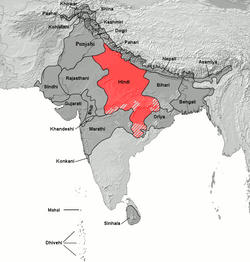
Eastern and Western Hindi, or Hindi proper, as outlined in this description.
If there can be considered a consensus within the dialectology of Hindi proper, it is that it can be split into two sets of dialects: Western and Eastern Hindi. This analysis excludes varieties sometimes claimed for Hindi, such as Bihari, Rajasthani, and Pahari. Thus Hindi proper includes —
- Western Hindi (of which Sauraseni is the immediate precursor):
- Braj, spoken in western Uttar Pradesh and adjacent districts of Rajasthan and Hariyana.
- Haryanvi or Bangaru, spoken in the states of Haryana and Delhi.
- Bundeli or Bundelkhandi, spoken in west-central Madhya Pradesh.
- Kannauji, spoken in west-central Uttar Pradesh.
- Kauravi or Vernacular Hindustani, spoken to the north and northeast of Delhi.
- Khari boli, the standard dialect, generally identified with the grammatical core of Kauravi (vernacular Hindustani), but displaying features of other dialects and adjacent languages, as well as non-Indic languages such as Persian. It is forms the basis of the standard registers of Modern Standard Hindi and Urdu.
- Eastern Hindi (of which Ardhamagadhi is the immediate precursor)
- Awadhi, spoken in north and north-central Uttar Pradesh and in Fiji.
- Bagheli, spoken in north-central Madhya Pradesh and central Uttar Pradesh.
- Chattisgarhi, spoken in southeast Madhya Pradesh and northern and central Chattisgarh.
In non-Hindi regions in the Indian subcontinent
- Urdu is the official language of Pakistan. Although only the mother tongue of 7% of the population, it is nearly universal as a second language.
- Bambaiya Hindi, the dialect of the city of Bombay (Mumbai); it is based on Hindustani but heavily influenced by Marathi and Gujarati. Technically it is a pidgin, i.e., neither is it a mother language of any people nor is it used in formal settings by the educated and upper social strata. However, it is often used in the movies of Hindi cinema (Bollywood) because Mumbai is the base of the Bollywood film industry.
- Dakhni - a form of Urdu spoken in Hyderabad, Andhra Pradesh.
- Kalkatiya Hindi, another Khariboli-based pidgin spoken in the city of Calcutta (Kolkata), Shillong, etc., heavily influenced by Bhojpuri and Bengali.
Outside the Indian subcontinent
- Mauritian Hindi, spoken in Mauritius, based on Bhojpuri and influenced by French.
- Sarnami, a form of Bhojpuri with Awadhi influence spoken by Surinamers of Indian descent.
- Fiji Hindi, derived form of Awadhi, Bhojpuri and including many English and native Fijian words, is spoken by Fijians of Indian descent.
- Trinidad Hindi, based on Bhojpuri, and spoken in Trinidad and Tobago by people of Indian descent.
- South African Hindi, based on Bhojpuri, and spoken in South Africa by people of Indian descent.










